Lab Scanner vs Intraoral Scanner: Which One Is Right for Your Dental Practice?
When it comes to digital impressions and CAD/CAM workflows, choosing the right scanning technology is crucial. Whether you’re a dental lab in the U.S. or a dentist looking to improve your practice’s efficiency, understanding the differences between a lab scanner and an intraoral scanner can help streamline your workflow, reduce errors, and improve patient satisfaction.
In this article, we break down the key features, advantages, and limitations of both types of scanners to help you decide which is best for your needs.
1. What is a Lab Scanner?
A lab scanner is a high-precision device used in dental labs to create 3D digital models of physical dental impressions. Typically, a dental impression or physical model is placed into the scanner, and the scanner then uses laser or structured light to capture detailed images and convert them into digital files for further processing.
Key Features of Lab Scanners:
-
Higher precision: Lab scanners are built to achieve extremely detailed and accurate scans of dental models or impressions.
-
Ideal for fixed restorations: Best for crowns, bridges, and other types of fixed restorations that require high precision.
-
Time-saving: Once the physical model is placed into the scanner, it takes just minutes to generate a digital file that can be used in CAD design and milling processes.
Why Choose a Lab Scanner?
-
Accuracy and reliability: Lab scanners offer a higher degree of precision compared to intraoral scanners, making them ideal for dental labs that handle detailed restorations like bridges, crowns, and implants.
-
Complex restorations: If your lab works with complex prosthetics or large cases, a lab scanner ensures that every detail of the model is captured.
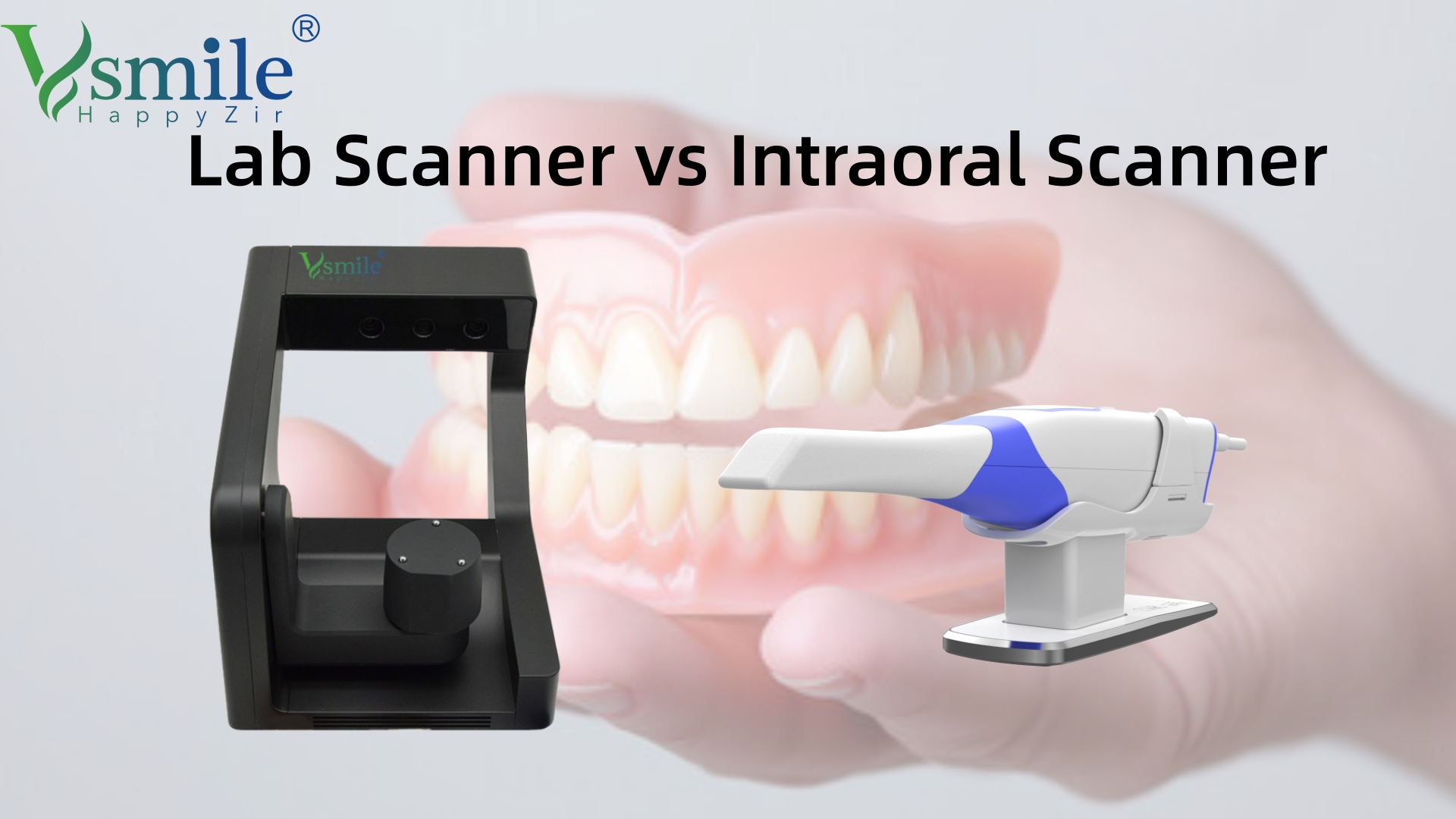
If you’re looking for high precision and speed in a controlled lab environment, a lab scanner like the Vsmile Dental Laboratory Desktop Scanner is a great investment. It is specifically designed to handle detailed models and offer consistent results.
2. What is an Intraoral Scanner?
An intraoral scanner, on the other hand, is a handheld device used by dentists to take digital impressions directly in the patient’s mouth. These scanners capture detailed 3D images of the teeth and gums, which can then be used for treatment planning, crowns, bridges, and other dental procedures.
Key Features of Intraoral Scanners:
-
Convenience and patient comfort: Intraoral scanners are small and portable, allowing for easy scanning directly inside the patient’s mouth. This eliminates the need for traditional impression materials, which some patients find uncomfortable.
-
Real-time imaging: These scanners provide real-time digital impressions, allowing both the dentist and patient to immediately view the results on a screen.
-
Less patient discomfort: No messy impression materials are required, leading to a more comfortable experience for the patient.
Why Choose an Intraoral Scanner?
-
Patient experience: Intraoral scanners are ideal for patients who have gag reflexes or sensitivity to traditional impressions. They are faster and more comfortable, making them a preferred choice for many patients.
-
Immediate results: The scanner provides instant digital impressions, which can be shared with the lab in real time. This can speed up the overall workflow, from initial consultation to final restoration.
-
Enhanced communication: Intraoral scanners enable better communication between dentist and lab, as the digital impressions can be instantly transferred, reducing the chances of errors in the process.
For practices looking for improved patient experience and a seamless workflow, an intraoral scanner such as Vsmile’s 3D Intraoral Scanner is a great option. With its high-speed scanning and real-time imaging capabilities, it ensures a smooth experience for both the dentist and patient.
3. Lab Scanner vs Intraoral Scanner: Key Differences
Precision and Use Cases:
-
Lab scanners are better suited for detailed work in the lab, such as fixed restorations (crowns, bridges, implants), offering higher accuracy for complex prosthetics.
-
Intraoral scanners are designed for live patient use. They’re ideal for routine restorative work, including crowns, veneers, and implant impressions, but may not provide the same level of fine detail as a lab scanner for intricate cases.
Workflow Integration:
-
Lab scanners are mainly used for post-impression work, where the patient’s physical model or traditional impression has been taken and sent to the lab. These scanners are integrated into the lab’s CAD/CAM systems for manufacturing and design.
-
Intraoral scanners, however, start the workflow directly in the dental office by eliminating the need for traditional impressions. The scanned data can be sent directly to the lab for further processing and fabrication, speeding up the process.
Patient Comfort:
-
Intraoral scanners provide a more comfortable, faster experience for patients compared to traditional impressions, and the digital process is less invasive.
-
Lab scanners do not interact with patients directly and are used for processing physical impressions, which can be more time-consuming but offer the highest level of accuracy.
4. Which One Should You Choose?
The decision ultimately depends on your specific needs and goals.
-
For dental labs focused on high-precision restorations, a lab scanner like the Vsmile Dental Laboratory Desktop Scanner is the best choice. It offers unparalleled accuracy and is perfect for creating highly detailed models needed for fixed restorations and complex prosthetics.
-
For dental practices looking to enhance patient comfort and streamline workflows, an intraoral scanner such as Vsmile’s 3D Intraoral Scanner can provide immediate, comfortable digital impressions, improving the overall patient experience and communication with the lab.
If your practice or lab is ready to upgrade to digital scanning, investing in either an intraoral or lab scanner can drastically improve both your workflow efficiency and patient satisfaction. Choose the one that best aligns with your specific requirements and workflow.
Final Thoughts
Understanding the differences between a lab scanner and an intraoral scanner is key to making an informed decision for your dental practice or lab in the U.S. Both technologies have unique benefits depending on the environment they are used in. By selecting the right scanner, you can improve accuracy, efficiency, and patient satisfaction, ensuring better overall results and profitability.
Explore the full range of digital scanning solutions from Vsmile:
Investing in the right equipment can set your practice a
Digital Solutions for Small Dental Labs: Insights for the Dominican Republic
When Should Dental Labs Use PEEK? A Practical Guide for Labs in the Dominican Republic
Related Article