Why Zirconia Crowns Lose Shade Consistency After Sintering

A Practical Troubleshooting Guide for Dental Laboratories and Milling Centers
A zirconia crown can look perfectly consistent before sintering—and then look noticeably different after firing.
The shade may become:
- darker or lighter than expected,
- more or less translucent,
- more saturated,
- more opaque,
- or simply different from another crown processed in the same laboratory.
For dental laboratories and milling centers, this is more than an aesthetic inconvenience. Unexpected shade variation can lead to additional characterization, remakes, longer production times, and difficulty maintaining consistent results across cases.
But there is an important point:
Shade variation after sintering does not automatically mean that the zirconia material is defective.
The final optical result is affected by the interaction between the zirconia material, coloring procedure, restoration thickness, sintering temperature, sintering time, and furnace conditions.
Scientific studies have demonstrated that changes in sintering conditions can affect the color and translucency of zirconia, although the magnitude and direction of the change depend on the specific zirconia system.
So when a crown comes out of the furnace with an unexpected shade, the right approach is not to immediately change the material.
It is to troubleshoot the entire process.
What Actually Determines the Final Shade of Zirconia?
The appearance of a zirconia restoration is not determined by one variable.
A useful way for a laboratory to think about the process is:
**Zirconia material
- shade/coloring
- restoration thickness
- CAD/CAM processing
- sintering protocol
- furnace performance
- finishing
= final optical result**
This is particularly important for modern multilayer and highly translucent zirconia.
The optical properties of zirconia are influenced by factors including composition, grain structure, porosity, pigments, thickness and processing conditions. A systematic review of zirconia's optical properties identified material composition and microstructure among the important factors affecting its esthetic behavior.
1. The Sintering Temperature May Be Different From the Programmed Temperature
One of the first things to investigate when shade consistency changes is the actual sintering condition.
A furnace program might specify a particular final temperature, but the laboratory should not assume that the programmed value alone guarantees the same thermal conditions in every cycle.
Temperature accuracy and stability depend on factors such as:
- furnace design,
- heating elements,
- calibration,
- sensor performance,
- furnace age,
- maintenance,
- loading conditions,
- and the specific firing program.
Research has shown that changing sintering temperature can affect zirconia's optical properties.
For example, a 2025 in-vitro study evaluating several translucent zirconias found that sintering at a temperature lower than the manufacturer's recommendation could reduce lightness and increase saturation and opacity.
This does not mean that a higher temperature is always better.
The important principle is:
Use the sintering temperature specified and validated by the zirconia manufacturer rather than adjusting temperature simply to obtain more translucency or a different shade.
2. Temperature Deviations Can Change Translucency
Color consistency and translucency are closely related.
A restoration that becomes more translucent may appear visually different even if its basic shade designation has not changed.
Research on multilayer zirconia found that deviations from the recommended sintering temperature significantly affected translucency. However, the direction of the change depended on the zirconia material.
This is important for laboratories using multiple zirconia brands.
You should not assume:
"If increasing temperature makes one zirconia more translucent, it will do the same thing to every zirconia."
Different zirconia systems can respond differently because their formulations and microstructures are different.
3. Sintering Time Matters Too
Temperature is not the only parameter.
Sintering time can also influence optical properties.
A study evaluating translucent 5Y zirconia found that changing sintering time affected translucency and produced color differences relative to the manufacturer's specified cycle, with the magnitude varying between the zirconia materials tested.
Therefore, changing a conventional program into a shorter cycle should not be treated as a simple time-saving adjustment.
For laboratories considering fast sintering, the critical question is:
Is this specific zirconia validated by its manufacturer for this sintering protocol?
4. Fast Sintering Is Material-Dependent
Fast sintering can be valuable for high-throughput dental laboratories.
It can shorten the time between milling and delivery, but fast sintering should not be treated as a universal replacement for conventional sintering.
A recent study comparing conventional and high-speed sintering across 3Y, 4Y and 5Y zirconias found that high-speed sintering altered translucency and color, with the effects varying according to yttria content and shade.
This leads to an important laboratory rule:
Before using a fast-sintering program, verify:
- The zirconia is approved for the protocol.
- The furnace supports the required firing profile.
- The manufacturer's temperature and time parameters are followed.
- The laboratory has validated the resulting shade and translucency.
Fast does not automatically mean worse.
But fast should always mean validated.

5. Zirconia Coloring Can Contribute to Shade Variation
Not all zirconia is supplied in exactly the same condition.
Depending on the product, laboratories may work with:
- white zirconia,
- pre-shaded zirconia,
- multilayer zirconia,
- coloring liquids,
- or combinations of these workflows.
Coloring procedures can therefore become another source of variation.
Important variables include:
- coloring liquid,
- concentration,
- application method,
- immersion time,
- drying,
- restoration geometry,
- and manufacturer instructions.
Research has specifically investigated the interaction between coloring and sintering on the optical and mechanical properties of monolithic zirconia. =
For a laboratory, the practical lesson is simple:
Standardize the coloring process just as carefully as the sintering process.
6. Restoration Thickness Can Change the Perceived Shade
Two crowns made from the same zirconia disc may not look identical if their thickness distributions are different.
Thickness influences how light is transmitted, absorbed and scattered through the restoration.
Research on zirconia has demonstrated that translucency varies with specimen thickness, and thinner zirconia can exhibit greater translucency.
This becomes particularly important with:
- anterior crowns,
- thin veneers or partial coverage restorations,
- translucent multilayer zirconia,
- minimal preparations,
- and restorations with significant thickness differences between cervical and incisal regions.
Therefore, a technician should not interpret every shade difference as a furnace problem.
7. Multilayer Zirconia Requires Extra Attention
Multilayer zirconia is designed to reproduce a gradual change in color and translucency across the restoration.
This creates excellent esthetic potential, but it also means the final appearance depends on the interaction between:
- disc composition,
- restoration position within the disc,
- restoration thickness,
- sintering parameters,
- and finishing.
For multilayer zirconia, laboratories should document where restorations are positioned within the blank and use consistent production protocols.
A change in material position can produce a different optical result even when the furnace conditions remain unchanged.
8. Furnace Loading Can Affect Process Consistency
A furnace does not operate in isolation.
The number and arrangement of restorations inside the chamber can influence the thermal environment.
For laboratories processing multiple units, it is therefore useful to standardize:
- tray type,
- restoration spacing,
- loading pattern,
- total load,
- support accessories,
- and program selection.
This is particularly important when comparing one production batch with another.
If a laboratory is trying to identify the cause of shade variation, changing several variables at the same time makes troubleshooting much more difficult.

9. Furnace Maintenance Should Not Be Ignored
If shade variation develops gradually rather than immediately, equipment condition deserves attention.
Potential areas to inspect include:
- temperature calibration,
- heating elements,
- temperature sensors,
- chamber condition,
- sintering trays,
- program settings,
- and maintenance history.
However, it is important not to claim that a particular component will cause a particular shade shift without evidence.
The better laboratory approach is:
Treat furnace condition as one variable in a controlled troubleshooting process.
A Practical Troubleshooting Sequence for Zirconia Shade Variation
When a laboratory notices that zirconia crowns are coming out with inconsistent shades, changing the zirconia immediately is usually not the most efficient first step.
Instead, work through the process systematically.
Step 1: Confirm the Material
Check:
- zirconia brand,
- product name,
- shade,
- lot/batch where applicable,
- manufacturing date if relevant,
- and whether the material has changed recently.
Step 2: Confirm the Sintering Program
Check:
- maximum temperature,
- heating rate,
- holding time,
- cooling process,
- and whether the selected program matches the material.
Do not rely on a generic "zirconia program" if the manufacturer specifies a different cycle.
Step 3: Check Coloring
If coloring is involved, confirm:
- same coloring liquid,
- same concentration,
- same application method,
- same drying process,
- and consistent operator procedure.
Step 4: Compare Restoration Thickness
Check whether the crowns being compared have similar:
- wall thickness,
- connector dimensions,
- occlusal thickness,
- and overall geometry.
Step 5: Check Furnace Condition
Review:
- calibration,
- maintenance,
- heating elements,
- sensor condition,
- previous firing results,
- and any recent furnace service.
Step 6: Run a Controlled Test
This is one of the most useful approaches.
Use:
- the same zirconia,
- the same shade,
- standardized specimens or comparable restorations,
- the same coloring protocol,
- the same sintering program,
- and controlled furnace loading.
Change one variable at a time.
This allows the laboratory to identify whether the variation is primarily associated with the material, coloring, geometry, firing protocol, or equipment.
What Should a Dental Laboratory Record?
For laboratories processing a large volume of zirconia, production records can make troubleshooting much easier.
A useful record may include:
| Parameter | What to Record |
|---|---|
| Zirconia | Brand / product / shade |
| Lot | Batch information where applicable |
| Restoration | Crown / bridge / full arch |
| Thickness | Approximate critical thickness |
| Coloring | Method and protocol |
| Furnace | Model / unit |
| Program | Program name |
| Temperature | Manufacturer-specified cycle |
| Holding Time | Program setting |
| Load | Number and arrangement of units |
| Result | Shade / translucency observation |
| Maintenance | Recent calibration/service |
Over time, these records can reveal patterns that are difficult to identify from visual inspection alone.
Why You Should Not Simply Increase the Temperature
This is one of the most important points for technicians.
When zirconia looks too opaque, it may be tempting to think:
"Let's increase the temperature."
When it looks too translucent:
"Let's lower the temperature."
This is not a reliable general rule.
Studies have demonstrated that the relationship between sintering temperature and translucency can vary between zirconia materials.
More importantly, changing the sintering parameters outside the manufacturer's validated protocol may affect more than appearance.
The sintering process is related to the development of the zirconia's microstructure and final properties.
Therefore:
Do not optimize color by trial-and-error temperature changes without considering the manufacturer's processing requirements.
What About the Sintering Furnace?
A high-quality furnace cannot compensate for an unsuitable zirconia program.
But a properly designed and maintained furnace can provide a more controlled environment for executing the manufacturer's recommended process.
When evaluating a dental zirconia furnace, laboratories should consider:
-
Temperature control
Can the furnace reliably execute the required temperature profile?
-
Thermal uniformity
Can restorations in different positions experience sufficiently consistent firing conditions?
-
Program flexibility
Can the laboratory use validated programs for different zirconia materials?
-
Repeatability
Can the furnace reproduce the same programmed cycle consistently?
-
Maintenance and calibration
Is there a clear procedure for keeping the furnace in stable operating condition?
-
Production efficiency
Can the furnace support the laboratory's actual workload without compromising validated firing protocols?
These questions are more useful than simply asking:
"What is the maximum temperature?"
Can a Fast-Sintering Furnace Maintain Shade Consistency?
The answer is:
It depends on the material, furnace, and validated firing protocol.
Fast sintering should not be judged simply by the number of minutes saved.
The real question is whether the complete process produces acceptable and reproducible results for the specific zirconia being used.
This distinction is particularly important because recent research has found that high-speed sintering can change translucency and color, and that the effect varies according to zirconia composition and shade.
For dental laboratories, the best practice is therefore:
Validate the fast-sintering protocol for each compatible zirconia system rather than assuming that one fast cycle works for every material.
A Simple Rule for Consistent Zirconia Shade
For laboratory teams, the entire concept can be summarized in one workflow:
Standardized Material
↓
Standardized Coloring
↓
Controlled CAD/CAM Processing
↓
Manufacturer-Recommended Sintering Program
↓
Stable Furnace Performance
↓
Consistent Finishing
↓
Repeatable Aesthetic Results
This is why shade consistency should be treated as a process-control issue, not simply a zirconia purchasing issue.
Frequently Asked Questions
Why do my zirconia crowns change color after sintering?
Sintering changes the zirconia's microstructure and optical properties. Shade variation can also be influenced by temperature, sintering time, coloring, thickness, material composition, and furnace conditions.
Does sintering temperature affect zirconia color?
Yes. Research has demonstrated that sintering temperature can affect zirconia color and translucency, although the effect depends on the specific zirconia system.
Why does my zirconia look more opaque after sintering?
Possible factors include the zirconia formulation, sintering temperature, sintering schedule, thickness, and microstructural development. A systematic review of zirconia optics also identifies material composition and microstructure as important factors.
Can fast sintering change zirconia shade?
Yes, it can. Recent research found measurable changes in color and translucency under high-speed sintering, with the effects varying by zirconia composition and shade.
Should I increase the furnace temperature if zirconia looks too opaque?
Not automatically. Follow the zirconia manufacturer's validated firing parameters. Different zirconia systems respond differently to temperature changes.
Does sintering time affect zirconia translucency?
Yes. Studies have found that changing sintering time can affect translucency and color, although the effect depends on the zirconia material.
Does zirconia thickness affect its appearance?
Yes. Thickness affects light transmission and therefore perceived translucency and color.
Is shade variation always caused by the furnace?
No. Material composition, coloring, restoration geometry, sintering parameters, and finishing can all contribute. The furnace should be evaluated as one part of the complete workflow.
Final Takeaway for Dental Laboratories
When zirconia crowns lose shade consistency after sintering, the solution is rarely as simple as "change the zirconia" or "change the temperature."
A more reliable approach is to control the entire workflow.
Check the material.
Check the coloring.
Check the restoration thickness.
Check the sintering program.
Check the furnace.
Then test one variable at a time.
Scientific evidence supports the conclusion that sintering parameters can influence the optical properties of zirconia. At the same time, studies also show that different zirconia materials can respond differently to changes in temperature and sintering time. PubMed
For a modern dental laboratory or milling center, consistent shade is therefore not simply a material issue—it is a workflow-control issue.
A reliable furnace should help the technician execute the manufacturer's validated sintering protocol consistently, while standardized material handling and coloring procedures complete the process.
About Vsmile's Zirconia Sintering Solutions
Vsmile develops zirconia materials and CAD/CAM equipment for digital dental laboratories and milling centers.
For laboratories working with different zirconia materials and production volumes, the goal is not simply to sinter faster. It is to establish a controlled, repeatable workflow from milling to final restoration.
Vsmile's zirconia and sintering solutions are designed to support laboratories in managing this workflow—from zirconia material selection and digital milling to validated sintering processes and final aesthetic finishing.
For specific zirconia products, always follow the manufacturer's recommended sintering parameters and processing instructions.
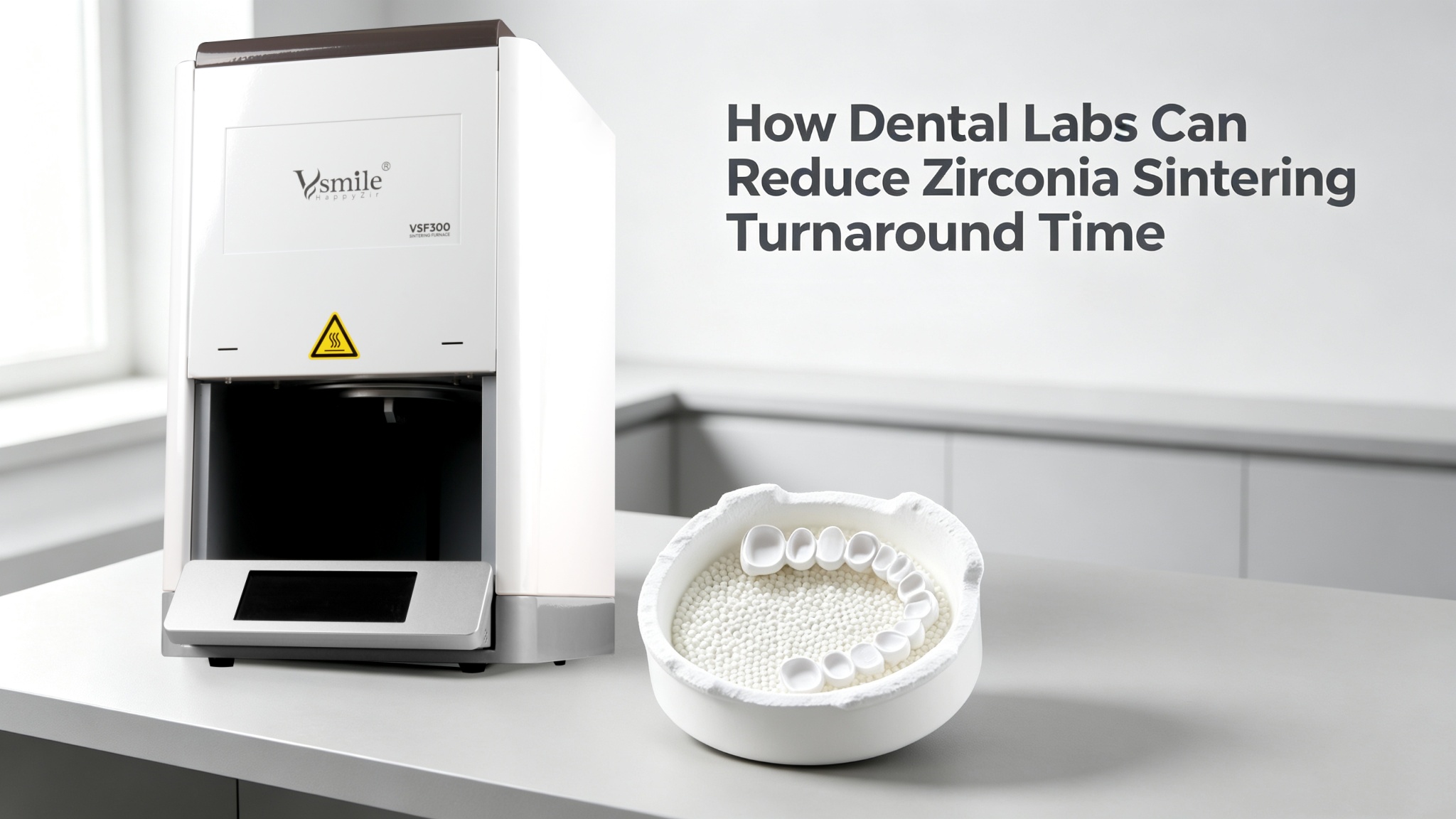
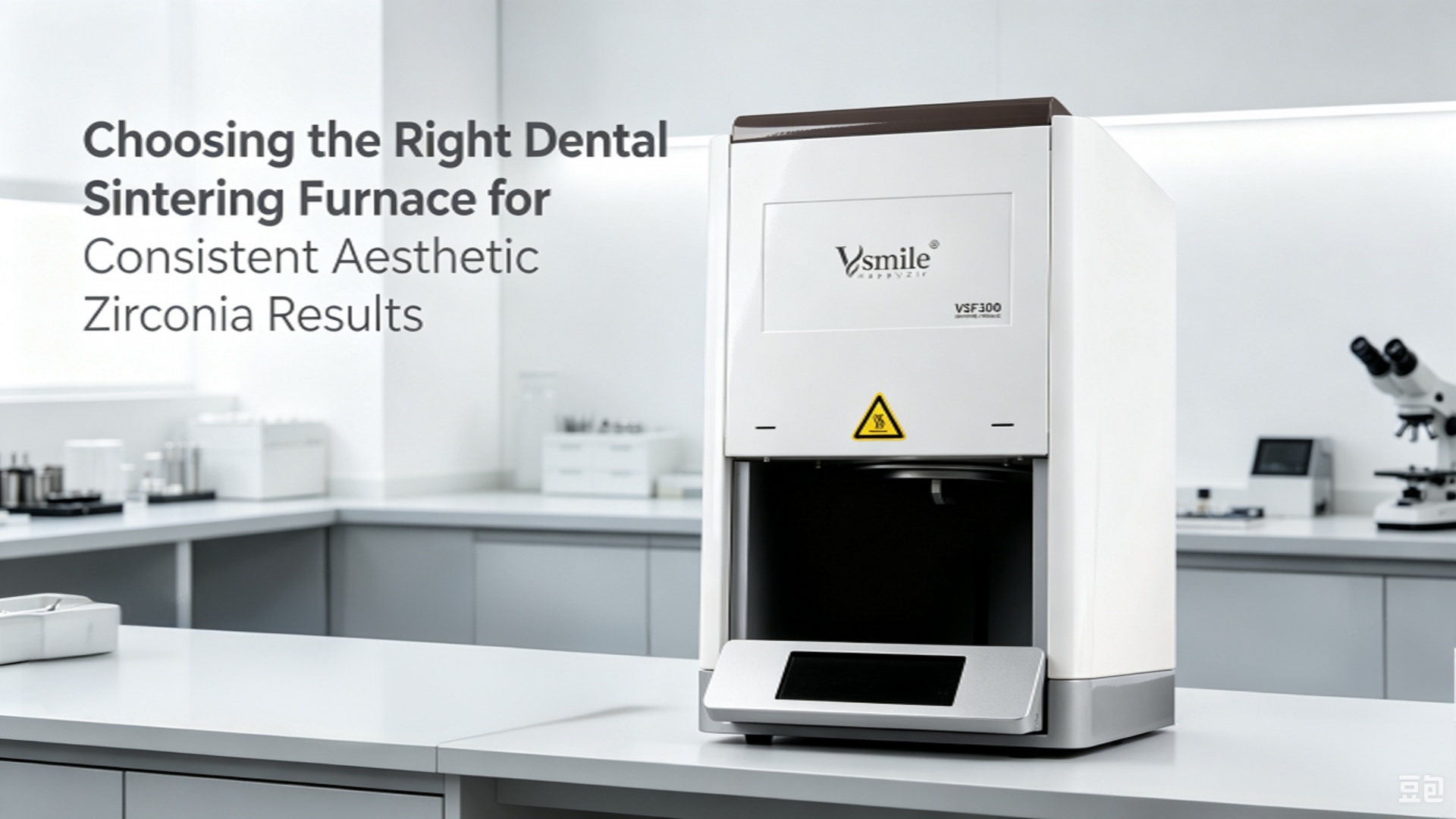
VSF300 fast sintering furnace | Fast-sintering workflow solution | Digital dental solutions
How Dental Labs Can Reduce Zirconia Sintering Turnaround Time