Cold Isostatic Pressing vs Binder-Based Zirconia: What Really Determines Block Quality in CAD/CAM Manufacturing
In dental CAD/CAM manufacturing, zirconia block performance is not only defined by chemical composition, but also by how the material is formed before sintering. Two major industrial routes dominate the market: binder-based spray-dried granulation and binder-free Cold Isostatic Pressing (CIP).
While both methods produce machinable zirconia blocks, their internal structure and long-term stability can differ significantly.
1. Binder-Based Zirconia: A Conventional Approach
Most traditional zirconia blocks are produced using a spray-drying process, where zirconia powder is mixed with organic binders and additives to form granules.
This process includes:
- Powder + binder mixing
- Spray drying into granules
- Pressing into green bodies
- Binder burnout during sintering
Although widely used, this method can introduce:
- Local density variation
- Potential binder distribution inconsistency
- Micro-porosity risks after burnout
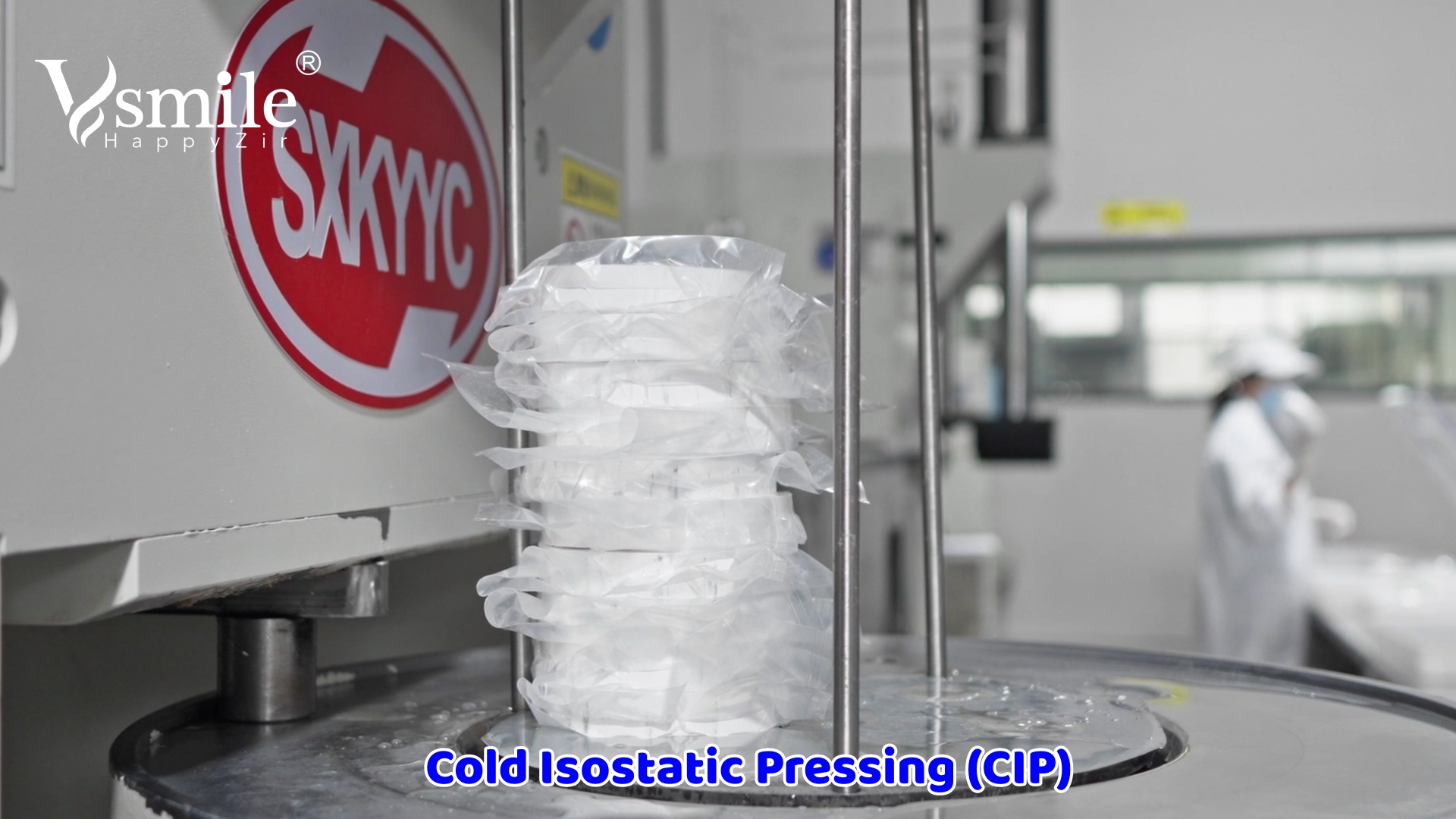
2. Cold Isostatic Pressing (CIP): A More Uniform Structure
Cold Isostatic Pressing eliminates the need for binder-driven granulation by applying uniform hydraulic pressure from all directions.
Key characteristics:
- No reliance on organic binder structure
- Multi-directional pressure compaction
- More homogeneous green body density
This leads to:
- More consistent shrinkage behavior
- Better internal structural uniformity
- Reduced weak-point formation
3. Why Structural Uniformity Matters
In zirconia CAD/CAM blocks, even small internal inconsistencies can influence:
- Milling stability
- Fracture resistance under load
- Dimensional accuracy after sintering
For single crowns, these differences may be minor.
For long-span bridges, they become critical.
The debate is not simply “binder vs no binder,” but rather control of internal material uniformity.
Cold Isostatic Pressing provides a more controlled and homogeneous foundation, especially suitable for complex restorative demands.
Choosing the Right Dental Sintering Furnace for Consistent Aesthetic Zirconia Results
Full-Arch Zirconia Fracture in All-on-X: What Really Causes It and How to Prevent It
Related Article