Full-Arch Zirconia Fracture in All-on-X: What Really Causes It and How to Prevent It
Introduction: When Strength Is Not Enough
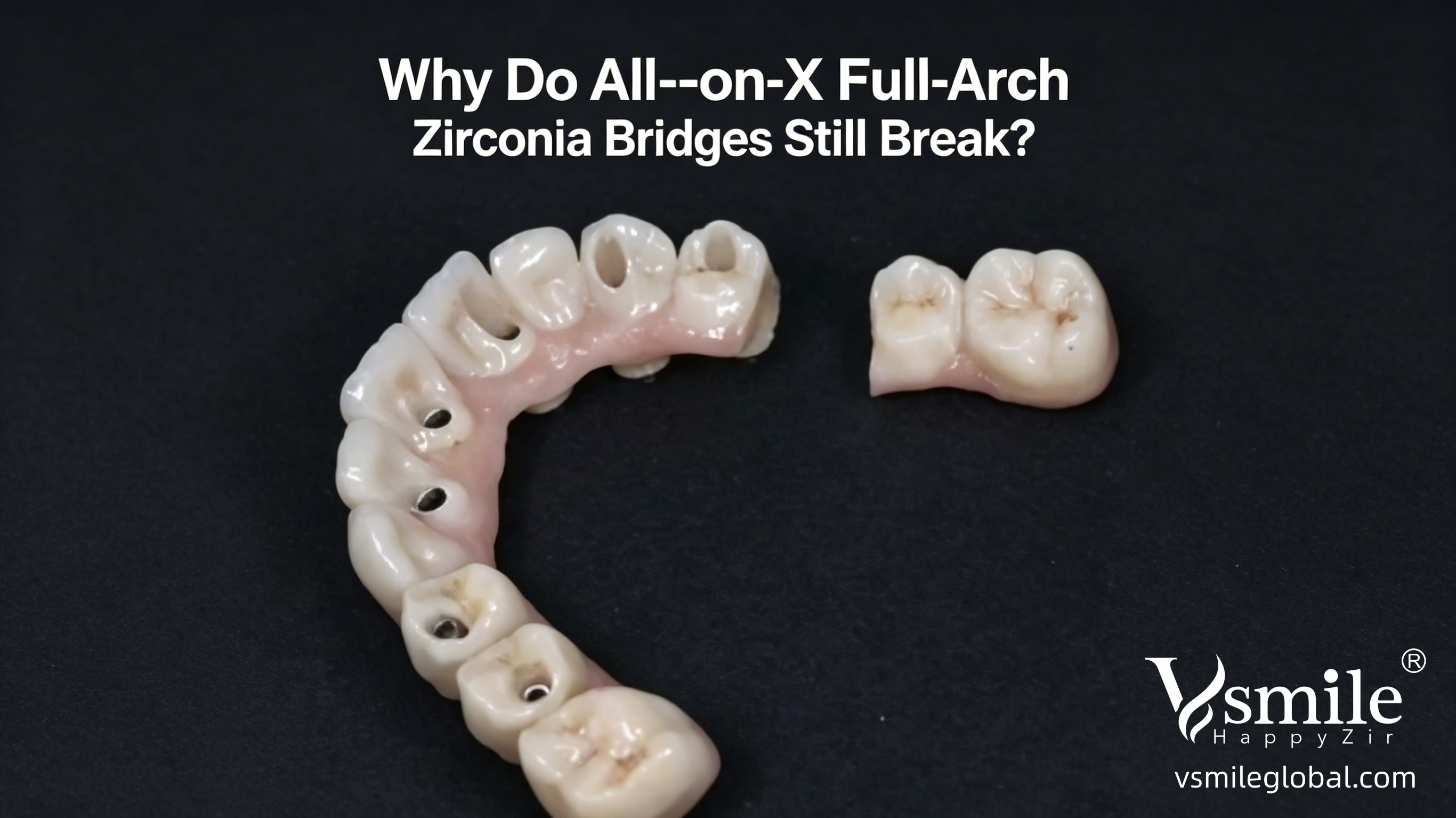
Zirconia block is widely recognized for its high strength and durability. Yet, in All-on-X full-arch restorations, fractures still occur—even when high-quality materials are used.
This indicates a critical point:
Fracture is not purely a material issue. It is a structural and system-level problem.
The Mechanics Behind Full-Arch Failure
Full-arch prostheses are exposed to complex loading conditions, including:
-
Repetitive bending forces
-
Off-axis loading
-
Cantilever stress
-
Fatigue over time
Under these conditions, two properties define performance:
Flexural Strength
Determines how much load the material can تحمل before failure.
Fracture Toughness
Determines whether existing microcracks will propagate under cyclic loading.
In fatigue-driven environments like full-arch restorations, fracture toughness often becomes the limiting factor.
Where Do Cracks Actually Start?
In most fractured zirconia bridges, failure originates from pre-existing defects, such as:
-
Surface damage from milling
-
Microcracks from grinding or adjustment
-
Sharp internal corners in connector areas
-
Residual stresses from sintering
These flaws are usually invisible—but under repeated load, they grow.
Connector Design: The Weakest Link
Clinical and laboratory observations consistently show that fractures often occur at connectors.
Key contributing factors:
-
Insufficient cross-sectional area
-
Narrow gingival embrasures
-
Sharp transitions instead of rounded contours
Increasing connector size and smoothing stress transitions can significantly improve fracture resistance.
Material Selection: Not All Zirconia Performs the Same
Different zirconia types behave differently under stress:
-
Higher yttria zirconia → better translucency, lower toughness
-
Lower yttria zirconia → higher strength and crack resistance
For long-span or high-load cases, selecting a material with higher fracture toughness is often more critical than maximizing aesthetics.
The Role of Processing in Long-Term Performance
Laboratory procedures play a major role in fracture risk:
-
Over-grinding without proper polishing introduces defects
-
Incorrect sandblasting parameters can weaken the surface
-
Inconsistent sintering can create internal stress
Standardization is essential to ensure reproducibility and reliability.
Clinical Factors That Amplify Risk
Even with ideal materials and design, clinical factors can increase failure probability:
-
Bruxism and parafunction
-
Uneven occlusal contacts
-
Hard opposing dentition
-
Implant distribution limitations
These factors should be considered early in treatment planning.
Think Beyond Material Strength
Reducing fracture in All-on-X restorations requires a shift in mindset:
-
From material selection → to system optimization
-
From strength focus → to fatigue resistance
-
From isolated steps → to controlled workflows
For dental labs and clinicians, success lies in understanding how design, material, and processing interact under real conditions.
Looking to improve consistency in your All-on-X zirconia cases? Contact us to discuss material options and workflow recommendations tailored for full-arch restorations.
Cold Isostatic Pressing vs Binder-Based Zirconia: What Really Determines Block Quality in CAD/CAM Manufacturing
Milling Titanium: What Small Dental Labs in the Dominican Republic Should Know
Related Article